

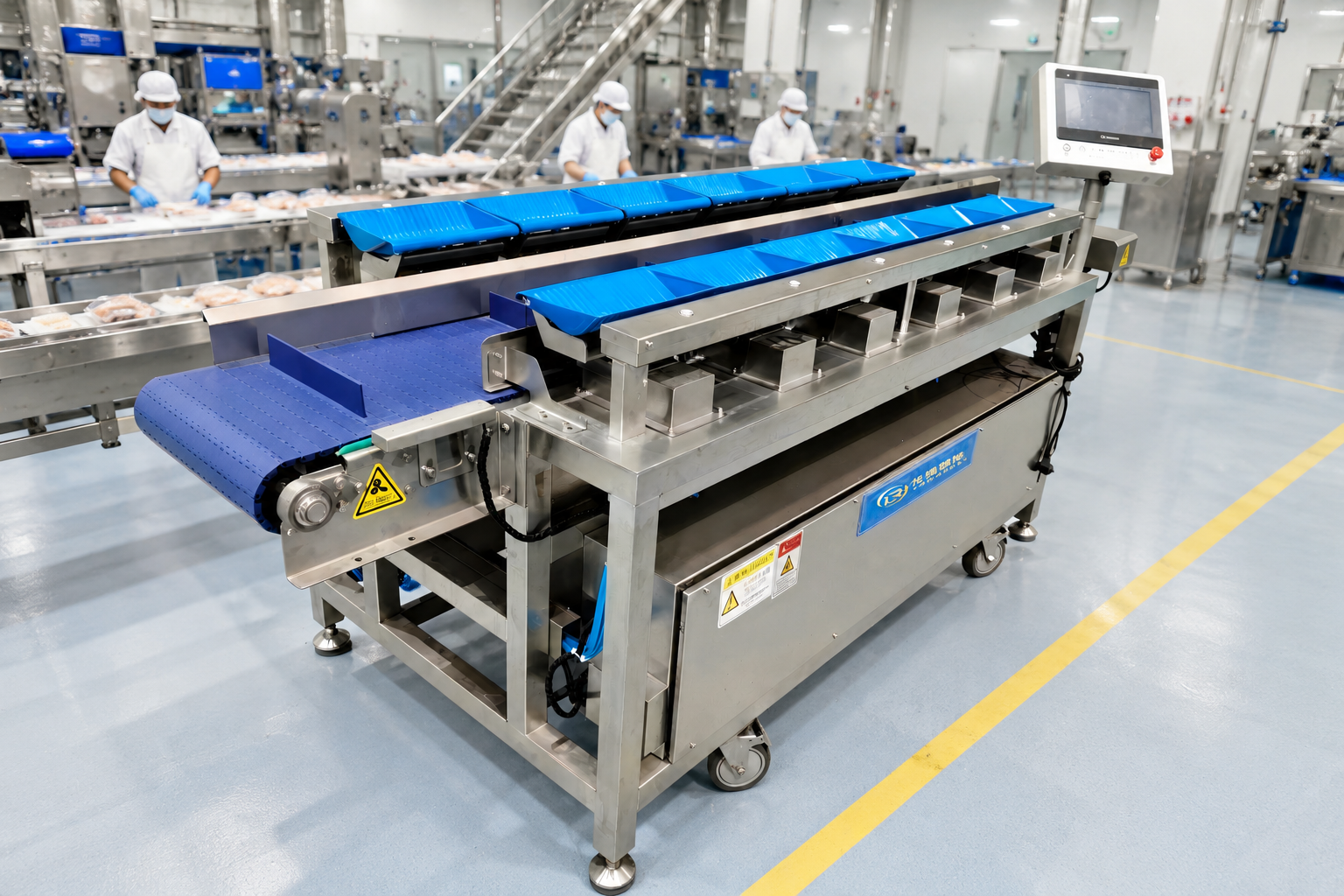
Selecting the right combination weigher (also widely known as a multihead combination weigher) is a pivotal investment for food processing plants and packaging lines. Factors such as product characteristics, target package weight, accuracy limits, and required line speeds directly influence the optimal machine configuration.
Among the most common industry solutions are 12-head, 16-head, 20-head, and 26-head combination weighers. The number of weighing heads (or hoppers) determines weighing flexibility, overall accuracy, speed, and suitability for single or multi-mix product applications.
If you are new to this technology, you can first review our detailed guide on How Does a Combination Weigher Work? to understand the core mechanical principles behind multihead weighing.
What Does the Number of Heads Mean in a Combination Weigher?
A multihead weighing system operates by dispersing bulk material into multiple individual weighing hoppers. A microprocessor instantly calculates hundreds of mathematical combinations to select the exact combination of hoppers that equals or comes closest to the target weight without going under.
A higher head count offers more available combination options per discharge cycle. This improves both combination weigher accuracy and output speed. However, choosing the best configuration requires balancing performance requirements with equipment costs:
- Physical product characteristics (e.g., sticky, fragile, or frozen items)
- Target package weight and tolerance limit
- Required packaging speed (Packs Per Minute / PPM)
- Factory space and level of automation integration
12-Head Combination Weigher: Practical & Cost-Effective
A 12-head combination weigher is a practical entry-level solution for standard food packaging applications. It is ideal for manufacturers making the transition from manual packing or linear weighers to automated packaging lines.
Common Applications:
- Standard portion frozen food packaging
- Fresh produce and vegetables
- Seafood products and snacks
Key Advantages:
- Stable weighing performance with dependable accuracy
- Compact footprint suitable for small factory layouts
- Highly cost-effective initial investment for small-to-medium operations
16-Head Combination Weigher: The Industry Workhorse
A 16-head combination weigher is one of the most versatile and widely deployed models in the food processing industry. Compared to a 12-head model, the additional hoppers generate significantly more weight combinations, allowing higher speeds with smaller weight variations.
Common Applications:
- Medium-to-high speed seafood processing lines
- Frozen food, poultry, and fresh meat packaging
- Confectionery, dry snacks, and bakery products
Key Advantages:
- Outstanding balance between price and performance
- Exceptional combination weigher accuracy at speeds up to 100-120 packs per minute
- Highly adaptable across diverse product types and hopper volume demands
20-Head Combination Weigher: High Speed & Multi-Mix Flexibility
A 20-head combination weigher is built for high-capacity production lines and multi-product weighing applications. The extra hoppers allow the machine to operate in single-discharge high-speed mode or split into dual/quad discharge sections to weigh multiple products simultaneously.
Common Applications:
- High-speed automated packaging lines (120–180+ PPM)
- Mixed-ingredient snack foods and frozen vegetable mixes
- Strict weight control environments requiring minimal give-away
Key Advantages:
- Vastly increased combination calculations for pinpoint accuracy
- Dual-discharge capability for enhanced versatility
- Continuous, high-reliability operation for large food factories
26-Head Combination Weigher: Maximum Output & Ultra-High Speed
A 26-head combination weigher represents top-tier technology for demanding industrial environments. It delivers extreme multihead weighing performance, handling complex multi-mix combinations or feeding multiple packaging machines concurrently.
Common Applications:
- Large-scale frozen food processing facilities
- High-output seafood processing plants
- Complex 4-in-1 multi-product mix packaging lines
Key Advantages:
- Maximum combination calculation power
- Superior line efficiency with reduced product giveaway
- Industrial-grade durability designed to meet strict international standards, including the FDA Food Safety Guidelines
12-Head vs 16-Head vs 20-Head vs 26-Head Comparison
| Model | Ideal Production Capacity | Target Packaging Speed | Main Operational Strength |
|---|---|---|---|
| 12 Head | Small / Entry-Level | Up to 60-70 PPM | Economical & reliable for basic weighing |
| 16 Head | Medium-to-High | 80-120 PPM | Best overall price-to-performance ratio |
| 20 Head | High Capacity / Multi-Mix | 120-180 PPM | Excellent accuracy & multi-product mixing |
| 26 Head | Industrial / Large Scale | 180+ PPM | Maximum throughput & multi-line distribution |
Frequently Asked Questions (FAQ)
How do I choose between a 16-head and 20-head combination weigher?
If your packaging line targets standard single-product output up to 100-120 packs per minute, a 16-head model offers the optimal balance of speed, accuracy, and ROI. If you require speeds exceeding 120 PPM or need to blend 2 to 4 different ingredients into one package, a 20-head model is recommended.
Can these multihead weighers handle sticky or frozen foods?
Yes. For sticky items like fresh poultry or frozen meat, combination weighers are customized with dimpled contact surfaces, Teflon non-stick coatings, or specialized feeding hoppers to ensure smooth product movement and prevent build-up.
How does hopper count affect giveaway and product loss?
More weighing hoppers provide a larger mathematical pool of combination options. This allows the computer controller to find weight combinations that are virtually identical to your target weight, reducing giveaway to fractions of a gram.